Student Aggression in Special Education: Prevention & Support


A typical math lesson is moving along smoothly when a student suddenly knocks books and pencils onto the floor. A few minutes later, another student kicks a paraprofessional during a transition. At the same time, a child escapes through the door because she can’t stand the hallway noise.
For many teachers, these kinds of incidents are all too common.
Student aggression in special education is arguably one of the most difficult situations that teachers, therapists, and support staff face. It can interfere with learning, compromise classroom safety, and leave teachers questioning themselves. However, such behaviours are often misunderstood. What seems like defiance or intentional misbehaviour is frequently a sign that a student is struggling to communicate, regulate emotions, or cope with their environment.
The good news is that aggression isn’t something that teachers just need to manage. Better understanding of the causes of aggression, proactive behavior intervention strategies, and regular behavior tracking can reduce acts of aggression while also empowering students to express their needs more appropriately!
What Is Student Aggression?
Aggression refers to behaviours that may cause harm to oneself, others, or the surrounding environment. In school environments, it can take many forms.
Aggression can include hitting, kicking, biting, scratching, pushing, throwing things, shouting, yelling and using threatening or hurtful language.
Keep in mind that aggression is a behaviour, not an identity. A student is not "an aggressive child." They are a child who displays aggressive behaviour in response to certain circumstances.
This differentiation matters because labels can shape expectations. When teachers focus on understanding the behaviour instead of defining the student by it, they are more likely to identify effective supports that address the underlying need and help the student.
Why Aggression Happens
Knowing what causes student aggression in special education is the first step towards stopping it. Some students don’t get aggressive to gain attention or avoid compliance. In many instances, aggressiveness is a child's way of dealing with situations they cannot yet manage on their own.
Many aggressive behaviours are actually attempts to send out a message or communicate distress.
Communication Challenges
Some students struggle to say that they are feeling frustrated, uncomfortable, confused, or in need of something. When they can’t communicate what they want or need through speech, gestures, or alternative means of communication, they resort to aggressive behaviour to communicate the issue.
For instance, a student who is unable to say, "This is just too hard," or "Can we take a break?" might instead become physically aggressive by throwing things or hitting someone. When a student learns how to communicate more functionally, these behaviours tend to decrease.
Sensory Overload
Some special education classrooms also serve students with sensory processing issues. For these learners, noisy environments, harsh fluorescents, crowded hallways, unexpected touch, or too much visual stimulation can become intolerable very quickly.
When the nervous system becomes overloaded, aggression emerges as part of a fight-or-flight response, rather than a thought-out, deliberate choice.
Difficult Transitions
Transitioning from one activity to another can be stressful, especially when schedules are altered without warning. A favourite activity ending, a substitute teacher arriving, or a modified schedule can all cause undue anxiety that students struggle to manage.
Advance warnings, visual schedules, and familiar routines and procedures can greatly ease stress related to transitions.
Task Demands
Sometimes, the trigger is the task itself. A task may feel too difficult, unreasonably long, or simply overwhelming and impossible based on the student's current skill level.
When a student experiences repeated frustration without sufficient support, she may turn to aggressive behaviors to escape from demands that feel impossible to meet.
Emotional Regulation Difficulties
Many students receiving special education services are still developing the ability to recognise emotions, calm themselves, and recover after stressful events.
When emotions escalate rapidly, they may not have the internal tools needed to regain control. This is where teaching emotional awareness and self-regulation skills becomes just as important as academic instruction.
Why Aggression Is More Common in Special Education
While aggression can occur in any classroom, several factors may increase its likelihood in special education settings.
Certain students have higher support needs that can affect communication, emotional regulation, executive functioning or sensory processing. Others may possess multiple disabilities or co-occurring behavioural issues that present additional challenges when navigating everyday routines.
These factors can’t cause aggressive behaviour themselves, nor does their existence always imply that aggressive behaviour is inevitable. They simply underscore why individualised supports matter so much.
Successful classrooms understand that students need varying degrees of structure, communication supports and environmental accommodations. When these supports are provided in a purposeful manner, many aggressive behaviours decrease because students no longer need them to communicate their frustrations.
The Hidden Problem: Missed Patterns
At first glance, most aggressive episodes appear random and unrelated. If one doesn't pay attention, one wouldn't really notice any connection between them.
In reality, however, patterns often exist beneath the surface.
Teachers can start spotting these patterns by considering some basic questions.
When does the behaviour occur? Where does it happen? During which activity? With which staff member? What happened immediately before the incident?
The answers are often surprising.
Maybe aggression always happens during transitions between classes. Maybe more incidents occur when students have to wait too long for staff to assist them or provide support. Perhaps a particular academic task is consistently triggering frustration.
In the absence of objective data, teams start relying on recall. However, recall is often incomplete and selective, and no two staff members can recall the same details and think of the same implications. This eventually leads to incomparable conclusions and ineffective support plans.
The first step in implementing positive behavior support strategies is to identify patterns. After all, behaviour interventions are most effective when they avoid treating the behaviour and instead treat its cause.
Prevention Starts Before the Behaviour
Responding safely to student aggression in special education is important, but prevention makes a far greater impact. Early intervention with simple measures can sometimes eliminate the need for crisis responses altogether.
Build Predictable Routines
Students need to know what to expect.
Visual schedules enable them to see what’ll happen next. Transition warnings can better prepare them for upcoming changes. Clear classroom expectations reduce uncertainty and help students understand what is expected throughout the day.
These simple positive behaviour support strategies and the consistency they provide ease children’s anxiety and boost their confidence.
Reduce Known Triggers
Stress can arise in any classroom situation.
To one student, loud noise may be very distracting. For another, having to wait several minutes for help may cause frustration. For a third student, completing a long assignment may be a challenge that exceeds their current abilities.
One of the most effective behaviour intervention strategies is to identify and eliminate the environmental triggers of aggression. It helps because it addresses the factors that lead to aggression before any aggressive behaviour happens.
Teach Replacement Skills
Simply telling students not to be aggressive doesn’t work if they don't have an alternative way to satisfy their needs.
Educators can explicitly teach replacement skills that serve the same purpose in a safer, more appropriate way. For example, students can be taught how to ask for a break, request assistance, utilise visual supports or AAC systems, recognise and name emotions, or communicate when something overwhelms them.
Students are more likely to use replacement skills in times of stress when those skills are also consistently practised when they’re calm.
Practice Co-Regulation
Adults can help students regain their emotional control.
When teachers back off, settle down, speak in a steady voice, and lower their expectations, students get regulated much faster. Escalated adult responses can unintentionally increase stress, while the steady, predictable patterns of adult behaviour can communicate safety.
De-escalation strategies for teachers that really work focus on addressing the emotion, not winning a power struggle. Supporting regulation first creates better opportunities for teaching and problem-solving afterwards.
Why Behaviour Tracking Matters
When decisions are made based on assumptions instead of data, preventing aggressive episodes becomes difficult.
Behaviour tracking in special education allows teams to see what occurred before, during, and after episodes of aggression. Instead of depending on isolated memories, educators can spot meaningful trends over time.
Useful data includes the antecedent, or what happened before the behaviour, the specific behaviour that occurred, the consequence or staff response, along with the frequency, duration, and intensity of the incident.
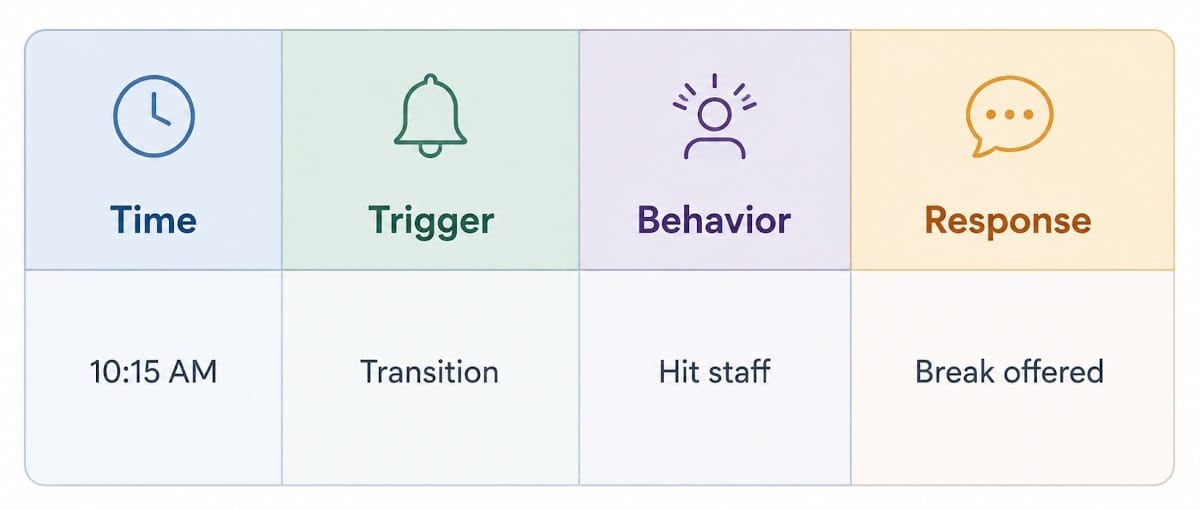
When information like this is collected consistently across classrooms and staff members, important patterns can emerge.
A team may notice that incidents occur more frequently in the afternoon than in the morning. They may find that aggression increases after changes in medication, on days with substitute staff, or when a preferred activity ends unexpectedly. Some students may even respond differently depending on the level of prompting or the number of peers nearby!
Armed with this knowledge, teachers can design behavior intervention plans that truly work, and supports can be built upon objective evidence rather than guesswork.
Turning Data Into Better Support
Behavior tracking in special education is great as long as it is consistent and usable by the entire educational community.
Tools like AbleSpace help teachers, therapists, paraprofessionals, and administrators document behaviour information in one centralised location. Instead of carrying around paper notes or documenting behaviour details in multiple spreadsheets, staff can record incidents in real time while ensuring everyone has access to the same information.
Over time, this shared data helps teams identify common triggers, spot shifts in behaviour, determine behaviour intervention effectiveness, and make more informed decisions during IEP meetings and progress checks.
Rather than reacting to individual incidents, teams can proactively adjust supports based on clear evidence. This creates more consistent intervention planning, improves communication across staff members, and ultimately contributes to safer, more supportive learning environments for both students and educators.
Supporting Students Also Means Supporting Staff
Discussions about aggression often focus solely on students, but educators deserve some support as well.
Aggressive incidents can affect educators’ physical and psychological safety, confidence, and overall job satisfaction. Continuous exposure to difficult behaviour, without enough resources to tackle the problem, can cause stress and burnout, even among experienced professionals.
Schools that offer training for their staff members, focus on collaborative problem-solving, and provide access to accurate data on behaviour create stronger teams that feel better prepared to respond effectively.
Supporting students and protecting educators are not opposing goals. Both matter!
When teachers feel safe, supported, and equipped with practical tools, they are better able to provide the calm, consistent guidance that every child needs in a classroom.
Conclusion
Student aggression in special education can feel unpredictable, but it doesn't have to remain that way. When educators focus on understanding the reasons behind behavior, teaching replacement skills, and using consistent data to guide decisions, they create safer classrooms and better outcomes for everyone. Every behavior communicates something. The better teams understand that message, the more effectively they can support each student's success.